
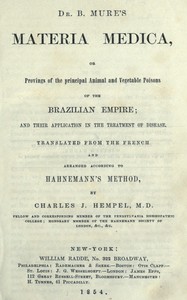
Dr. B. Mure's materia medica : or, provings of the principal animal and…
Let's be clear from the start: this isn't a storybook. There's no protagonist on a quest, no villain to defeat. 'Dr. B. Mure's Materia Medica' is a reference work, a catalog of experiments. Published in the mid-1800s, it's the life's work of Benoît Mure, a passionate advocate for homeopathy. The 'plot' is the process. Mure believed the key to healing was the 'Law of Similars'—the idea that a substance which causes certain symptoms in a healthy person can cure those same symptoms in a sick person.
The Story
The 'story' here is the method. To build his medical catalog, Mure and his colleagues conducted 'provings.' They would take a substance—like the venom of a rattlesnake, the sting of a honeybee, or milk from a nursing mother—and administer it to a healthy volunteer (often themselves). Then, they would meticulously record every physical and mental effect for days or weeks. Headaches, strange dreams, joint pains, shifts in mood—nothing was too small to note. This book compiles thousands of these observations, organizing them by substance. It's a raw, unfiltered log of the human body's reaction to toxins and compounds, seen through the very specific lens of 19th-century homeopathic theory.
Why You Should Read It
You read this not for a narrative, but for a perspective. It’s a direct line to a moment in history when medicine was a personal, experiential frontier. The bravery (or recklessness) is astounding. The dedication to detail is equally impressive. Reading these clinical notes, you get a strange intimacy with these long-gone experimenters. You see their convictions in every line. It makes you think about how we know what we know about our bodies and our medicines. Our modern system is built on clinical trials and peer review; Mure's world was built on individual testimony and philosophical principle. The contrast is gripping.
Final Verdict
This book is a niche treasure. It's perfect for history buffs, especially those interested in medicine, alternative science, or the Victorian era. It's also great for anyone who likes primary sources—the raw data of history. If you enjoy books like 'The Medical Detective' or are fascinated by the odd corners of scientific history, you'll find this compelling. Just don't expect a traditional story. Approach it like an archaeological dig into the mind of a believer, and you'll be rewarded with a truly unique glimpse into the past.
This text is dedicated to the public domain. It is available for public use and education.
Joseph Walker
11 months agoIf you enjoy this genre, the storytelling feels authentic and emotionally grounded. Absolutely essential reading.
Mason Jackson
3 months agoJust what I was looking for.
Oliver Taylor
2 years agoWow.
Carol Wilson
1 year agoBeautifully written.



Matthew Martin
1 year agoRecommended.