
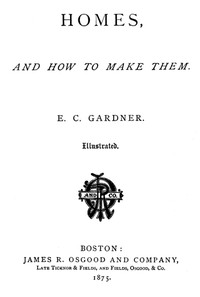
Homes and How to Make Them by E. C. Gardner
Published in 1874, Homes and How to Make Them is a book that completely disguises its purpose. At first glance, it might look like a dry manual. Instead, Gardner writes it as a story. We follow the journey of John and Helen, a newly married couple with big dreams and a very modest budget. They want to build a comfortable, sensible house, but they're quickly overwhelmed by the thousands of choices and conflicting advice from friends and builders.
The Story
The entire book is told through their letters to each other and to their friend, an architect they call 'C.' John is often swayed by fancy, expensive ideas he sees in grand homes. Helen is the practical voice, worried about cost and everyday livability. Their debates cover everything from the ideal orientation of the house to catch sunlight, to the placement of the kitchen (should it be hidden or convenient?), to the eternal question of how much porch is too much porch. Architect 'C.' acts as their guide, patiently explaining why a simple, well-planned design is better than a complicated, cheaply-built one. There's no murder mystery or grand romance—the drama is in whether they'll blow their budget on a fancy staircase or finally agree on a floor plan.
Why You Should Read It
What blew me away was how modern the core problems feel. John and Helen struggle with 'keeping up with the Joneses,' balancing wants vs. needs, and finding honest contractors. Gardner, through 'C.', argues for simplicity, good materials, and thoughtful design over ornament and show. It’s a philosophy that feels very fresh today. Reading their letters, you get a fascinating peek into Victorian middle-class life—what they valued in a home (airflow! sunlight! sensible parlors!) and the social pressures they faced. It’s also quietly funny. Helen’s exasperation with John’s ever-changing ideas is something anyone who’s ever planned a project with a partner will recognize instantly.
Final Verdict
This is a perfect little read for history lovers, architecture nerds, or anyone who enjoys HGTV. It’s not a page-turning thriller, but a slow, charming, and insightful conversation. You'll come away with a new appreciation for the thought that goes into the walls around you, and maybe even some timeless advice for your own space. Think of it as a warm, witty letter from the past about the universal struggle to create a place called home.
No rights are reserved for this publication. Preserving history for future generations.
William Miller
1 month agoThe layout is perfect for tablet and e-reader devices.
Deborah Perez
8 months agoEssential reading for students of this field.
Jennifer Perez
2 years agoThis is one of those stories where the atmosphere created is totally immersive. Don't hesitate to start reading.
Joseph Allen
6 months agoTo be perfectly clear, the arguments are well-supported by credible references. Don't hesitate to start reading.







Christopher Moore
1 year agoBefore I started my latest project, I read this and the way the author breaks down the core concepts is remarkably clear. A rare gem in a sea of mediocre content.