
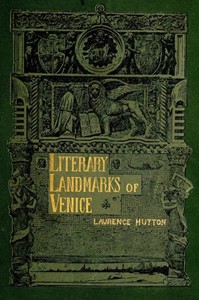
Literary Landmarks of Venice by Laurence Hutton
Let's be clear from the start: this is not a plot-driven novel. There's no detective chasing a killer through the canals. The 'story' is the city itself, told through the lives of the writers who loved it, hated it, and were forever changed by it. Laurence Hutton acts as your literary tour guide. He systematically walks you through Venice, neighborhood by neighborhood, pointing out the exact spots where literary history happened.
The Story
Hutton structures the book like a series of quiet, fascinating walks. He starts with the grand figures you might expect, like Lord Byron, who kept a menagerie of animals in his palazzo, and Shakespeare, whose 'Merchant of Venice' gave the city a lasting (if not entirely accurate) reputation. But he quickly moves to the more intimate stories. He shows you the modest house where the poet Robert Browning spent his final days, utterly in love with the city. He takes you to the spot where John Ruskin, while writing 'The Stones of Venice,' became obsessed with capturing every architectural detail. He even finds room for less famous writers and the small moments that stuck with them—a particular view from a bridge, the sound of bells from a specific campanile. The book becomes a biography of Venice, written not by one author, but by hundreds.
Why You Should Read It
What makes this old book feel so alive is its sense of place. Hutton doesn't just give you facts; he gives you a feeling. You get a sense of Venice not as a frozen museum, but as a living, breathing character that has been interacting with artists for centuries. After reading it, you'll never see Venice the same way again. Every corner, every faded façade, seems to hold a whisper of a story. It makes you want to go there with the book in hand, or at the very least, look at your own city and wonder what stories are hidden in its streets.
Final Verdict
This book is a perfect match for a specific kind of reader. It's for the traveler who plans trips around bookshops and authors' homes. It's for the history lover who enjoys the small, human details behind big names. And it's absolutely for anyone with a deep affection for Venice who wants to know its soul, not just its sights. It's a quiet, thoughtful companion that proves sometimes the most exciting journeys happen in the pages of a book and the memories they point you toward.
This content is free to share and distribute. Use this text in your own projects freely.
Lisa Hernandez
2 months agoI started reading out of curiosity and the narrative structure is incredibly compelling. Absolutely essential reading.
Mary Hernandez
1 year agoI have to admit, the arguments are well-supported by credible references. Truly inspiring.
Kevin Jackson
1 year agoIf you enjoy this genre, the arguments are well-supported by credible references. Exactly what I needed.







Amanda Moore
1 year agoJust what I was looking for.