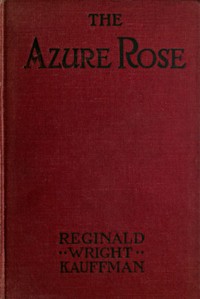
The Azure Rose: A Novel — Story, Setting & Ideas

(0 User reviews)   494
Kauffman, Reginald Wright, 1877-1959 Project Gutenberg 2011 Not confirmed
Paris (France) -- Fiction; País Vasco (Spain) -- Fiction Readers of public-domain and historical texts
Project Gutenberg digital edition en

Edition facts

Words 56,627
Reading time 247 min
Text sections 7

The source record for The Azure Rose: A Novel — Story, Setting & Ideas measures this digital text at 56,627 words, 4 hr 7 min estimated reading time, and 7 detected text sections.

The text analysis averages about 15.3 words per sentence, while the detected sections provide another way to judge how the source is divided.

Project Gutenberg metadata also associates the work with “Paris (France) -- Fiction,” connecting these edition facts with the source record’s subject description.

An editorial note on Reginald Wright Kauffman's 1919 novel set in Paris and the Basque Country, focusing on the author's diction, dialogue, and descriptive choices in scenes of courtship and evasion.
Share
Editorial Edition Score 4.7/5

Calculated from edition completeness, EPUB availability, text structure and catalogue metadata. Not a user rating.

How this score is calculated
  • Description quality20 pts
  • Title & short description10 pts
  • Source metadata20 pts
  • Text length15 pts
  • Chapters / structure15 pts
  • EPUB file integrity20 pts

Total of 100 points, scaled to a 2.5-5.0 range. Editions with an empty description or a missing EPUB file are not scored.

Edition quality

Read the Text

Song had shunned her traces, Care was on her track: All my young girls' faces Pale in folds of black! Half the hearts were broken, All the mirth was fled; Scarce a vow was spoken, Save above the dead....

Oh, but there's a spirit Sorrow cannot kill! Even now I hear it Swear the great "I Will!" Paris, at your portal Taps the ancient truth, Laughing and immortal: Never-conquered Youth! R. W. K.

IN WHICH, IF NOT LOVE, AT LEAST ANGER, LAUGHS AT LOCKSMITHS

Je ne connais point la nature des anges, parce que je ne suis qu'homme; il n'y a que les theologiens qui la connaissent.--Voltaire: _Dictionnaire Philosophique_.

He did not know why he headed toward his own room--it could hold nothing that he guessed of to welcome him, except further tokens of the dejection and misery he carried in his heart--but thither he went, and, as he drew nearer, his step quickened. By the time that he entered the rue du Val de Grace, he was moving at something close upon a run.

He hurried up the rising stairs and into the dark hall, and, as he did so, was possessed by the sense that somebody had as hurriedly ascended just ahead of him. The door to his room was never locked, and now he flung it wide.

The last of the afterglow had all but faded from the sky, and only the faintest twilight, a rose-pink twilight, came into the studio. Rose-pink: he thought of that at once and thought, too, that these sky-roses had a sweeter scent than the roses of earth, for there was about this once-familiar place an odor more delicate and tender than any he had ever known before. It was dim, illusive; it was like a musical poem in an unknown tongue, and yet, unlike French scents and hot-house flowers, it subtly suggested open spaces and mountain-peaks. Cartaret had a quick vision of sunlight upon snow-crests. He wondered how such a perfume could find its way through the narrow, dirty streets of the Latin Quarter and into his poor room.

And then, in the dim light, he saw a figure standing there.

Cartaret stopped short.

An hour ago he had left the place empty. Now, when he so wanted solitude, it had been invaded. There was an intruder. It was---- yes, the Lord have mercy on him, it was a girl!

"Who's there?" demanded Cartaret.

He was so startled that he asked the question in English and with his native American accent. The next moment, he was more startled when the strange girl answered him in English, though an English oddly precise.

"It is I," was what she said first, and, as she said it, Cartaret noted that her voice was a wonderfully soft contralto. What she next said was uttered as he further discovered himself to her by an involuntary movement that brought him within the rear window's shaft of afterglow. It was:

"What are you doing here?"

She spoke with patent amazement, and there were, between the words, four perceptible pauses.

What was he doing there? What was _she_? What light there was came from behind her: he could not at all make out her features; he had only her voice to go by--only her voice and her manner of regal possession--and with neither was he acquainted. Good Heavens, hadn't he a right to come unannounced into the one place in Paris that he might still call his own? It surely _was_ his own. He looked distractedly about him.

"I thought," said Cartaret, "that this was my room."

His glance, bewildered as it was, nevertheless assured him that he had not been mistaken. His accustomed eye detected everything that the twilight might hide from the eye of a stranger.

Kauffman's prose in The Azure Rose often shifts between a narrator's wry commentary and the characters' own voices, as when Cartaret reflects that Chitta's 'unsophisticated mind should have been improved by a thorough knowledge of picturesque Paris'—a line that undercuts his own schemes. The author favors a detached, slightly ironic tone in describing Cartaret's attempts to elude the chaperone, calling them 'some rather shabby tricks' that are 'almost uniformly unsuccessful.' This self-aware narration creates a playful tension between the hero's romantic aspirations and the comic obstacles of propriety.

Dialogue and the Language of Restraint

Kauffman crafts dialogue that reveals character through what is left unsaid. When Vitoria tells Cartaret, 'It is a subject that I am forbidden to think about,' her deliberate phrasing and the subsequent silence—'Her voice dropped into silence'—convey a prohibition that is both external and internal. The author avoids melodrama; instead, Vitoria's words are 'slow and deliberate,' her eyes showing 'something at once firm and sad.' Cartaret's own speech is marked by hesitation: he 'choked on the word' when approaching the topic of marriage. These verbal tics give the exchange a naturalistic weight, grounding the romantic tension in believable restraint.

Descriptive Economy in the Montmartre Scene

The ascent to Sacré-Coeur is rendered through sensory detail and spatial precision. Kauffman notes the 'steep ascent,' the 'Byzantine nave,' and the 'flying-start up the stairs to the tower,' using active verbs to maintain momentum. The view from the ramparts is described with a cartographer's eye: 'Paris lay like an outspread map,' with specific landmarks—'the roof of the Opéra, the gilt dome of Napoleon’s tomb and the pointing finger of the Tour Eiffel'—picked out before the city 'merged into a common maze.' This shift from particular to general mirrors Cartaret's own focus narrowing to Vitoria. The description of her 'panting a little,' 'cheeks flushed,' and 'whole face glowing' is economical but vivid, avoiding excess while conveying her physical presence.

The Chaperone as Comic and Structural Device

Chitta, the guardian, functions as both a physical obstacle and a source of dry humor. Kauffman establishes her through repeated, almost mechanical actions: she is 'always two feet behind, never closer, but never farther away.' Her piety—or exhaustion—keeps her 'long upon her knees' in the church, allowing the lovers a brief escape. The narrator notes her 'heavy breathing and muttered imprecations,' a detail that humanizes her while underscoring her role as a blocking figure. Cartaret's 'malign suggestion' to climb Montmartre, knowing Chitta fears the funicular, shows his strategic thinking, yet the author undercuts his triumph by having Chitta's slower pace still dictate the timing. This balance between farce and frustration gives the pursuit a rueful quality.

Authorial Voice and the Preface's Promise

Kauffman's preface frames the novel as 'a retrospect and a prophecy,' written after nine months on the Western Front. He insists the story is 'without problems and without horrors,' aiming only to give pleasure. This intention shapes the prose: the narrator's wry asides—'He was guilty of trying to elude the guardian—guilty of some rather shabby tricks'—maintain a light tone even when the hero's emotions run high. The author's choice to set the love story against a war-torn Paris, yet keep the war offstage, is a deliberate structural decision. The result is a narrative that acknowledges darkness without dwelling on it, focusing instead on the 'Parisian bravery in pain' and the persistence of romance. The reader is invited to enjoy the pursuit, the evasion, and the carefully measured dialogue without expecting a resolution to the larger conflict.

Readers attentive to Kauffman's craft will notice how he uses small gestures—a glance, a pause, a muttered imprecation—to build character and tension. The novel's pleasure lies not in grand revelations but in the texture of its scenes: the climb, the view, the guarded conversation. Approach it as a study in restraint, where what is withheld matters as much as what is said.

That editorial note on The Azure Rose kept me thinking about how escape changes a voice—how courtship and running share the same quiet breath. It reminded me of something earlier, darker, where words hide more than they reveal. In a Glass Darkly, v. 1/3 — Background and Themes sat beside it in my mind, not as a comparison, just a lingering shadow. Both left me strangely still.

There are no reviews for this eBook.

0
0 out of 5 (0 User reviews )

Add a Review

Your Rating *
There are no comments for this eBook.

Reader reflection

Before you leave, reflect on the book

Use these questions to collect your thoughts before moving on.

Your progress 0 / 10
1

Where are you in your reading?

2

How did the book work for you overall?

3

How likely are you to recommend this book?

4

What was the reading difficulty like?

Related eBooks