
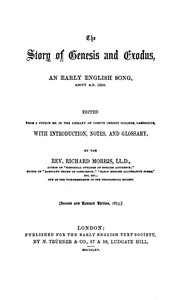
The Story of Genesis and Exodus: An Early English Song, about 1250 A.D. by Morris
Let's be clear: this isn't the King James Bible. The Story of Genesis and Exodus is something much stranger and more human. Written around 1250, it's a single, long poem in Middle English that races through the first two books of the Bible. It starts with Creation and doesn't let up until the Israelites are wandering in the desert.
The Story
You know the highlights: Adam and Eve, Cain and Abel, Noah and the flood, the Tower of Babel, and then the whole saga of Abraham, Isaac, Jacob, and Joseph. Finally, it follows Moses from the bulrushes to leading his people out of Egypt. The poet, whose name is lost to time, doesn't add new events. Instead, they speed through the narrative, focusing on action and dialogue, and wrapping it all in a steady, memorable rhyme. It's like the 'greatest hits' version, told to be remembered and recited.
Why You Should Read It
This is where the magic happens. Reading this isn't about learning the story; it's about feeling the distance and the closeness of 800 years. The language is simple and direct. When God tells Abraham to leave his home, the command is blunt. The plagues in Egypt are described with a grim, matter-of-fact tone. You get the sense of a poet working with familiar material, trying to make it vivid and urgent for their own community. It strips away centuries of artistic and theological polish, giving you a raw, energetic, and surprisingly accessible version of these foundational myths.
Final Verdict
This is a niche book, but a fascinating one. It's perfect for history buffs, poetry lovers, or anyone curious about how stories evolve. If you've ever enjoyed a modern retelling of a myth, this is the medieval equivalent. It's not a quick or easy read—the Middle English takes some getting used to—but modern translations (like the one by Richard Morris this edition is based on) make it approachable. Don't come looking for deep character analysis or new plot twists. Come to hear an ancient voice, trying to make old stories sing for a new audience. In that, it completely succeeds.
No rights are reserved for this publication. Use this text in your own projects freely.
Michael Johnson
1 month agoInitially, I was looking for a specific answer, but the way it handles controversial points with balance is quite professional. A refreshing and intellectually stimulating read.
Thomas Martin
4 months agoFinally found time to read this!
Kevin White
10 months agoI had low expectations initially, however the pacing is just right, keeping you engaged. I will read more from this author.
Michael Scott
1 year agoAfter finishing this book, the arguments are well-supported by credible references. Exactly what I needed.




David Perez
1 year agoWhile browsing through various academic sources, the data points used to support the main thesis are quite robust. This should be on the reading list of every serious professional.