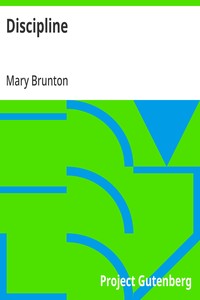
Discipline — Reading Notes

(0 User reviews)   1836
Brunton, Mary, 1778-1818 Project Gutenberg 2012 Not confirmed
Christian life; Great Britain -- Social life and customs -- Fiction; Young women -- Conduct of life -- Fiction Readers of public-domain and historical texts
Project Gutenberg digital edition en

Edition facts

Words 160,624
Reading time 699 min
Text sections 13

Before opening Discipline — Reading Notes, the edition data offers a quick orientation: 160,624 words, 11 hr 39 min estimated reading time, and 13 detected text sections.

The text analysis averages about 23.9 words per sentence, while the detected sections provide another way to judge how the source is divided.

Project Gutenberg metadata also associates the work with “Christian life,” connecting these edition facts with the source record’s subject description.

Mary Brunton's Discipline follows a young woman's journey from self-willed independence to moral and spiritual reflection, set against the social customs of early 19th-century Britain. The narrator's candid self-examination and the tension between personal desire and duty drive the narrative.
Share
Editorial Edition Score 4.8/5

Calculated from edition completeness, EPUB availability, text structure and catalogue metadata. Not a user rating.

How this score is calculated
  • Description quality20 pts
  • Title & short description10 pts
  • Source metadata20 pts
  • Text length15 pts
  • Chapters / structure15 pts
  • EPUB file integrity20 pts

Total of 100 points, scaled to a 2.5-5.0 range. Editions with an empty description or a missing EPUB file are not scored.

Edition quality

Read the Text

There was such irresistible mildness in the manner of this expostulation, that I could not disregard it; and I was checking my horses at the moment, when my beau, who had fallen behind, suddenly passed me. He gave them a triumphant smack with his whip, and the high-mettled animals sprang forward with a vigour that baffled my opposition: At this moment a decent-looking woman, in standing aside to let me pass, unfortunately threw herself into the line of his course; and I felt the horror which I deserved to feel, when my companions, each bounding over her, left her lying senseless within a step of the destruction which I had lost the power to avert.

From the guilt of murder I was saved by the fortitude of a stranger. He boldly seized the rein; and, with British strength of arm turning the horses short round, they reared, backed, and in an instant overturned the carriage. The stranger, alarmed by this consequence of his interference, hastened to extricate Miss Mortimer and myself; while our jockeys, too intent on the race to look back, were already out of sight.

Miss Mortimer looked pale as death, and trembled exceedingly; yet the moment she was at liberty she flew to the poor woman, whom the stranger raised from the ground. They chafed her temples, and administered every little remedy which they could command, while I stood gazing on her in inactive alarm. At length she opened her eyes; and so heavy a weight was lifted from my heart, that I could not refrain from bursting into tears; but unwilling to exhibit these marks of a reproving conscience, I turned proudly away.

It soon appeared that the woman was not materially hurt,--the horses, more sagacious and humane than their riders, having cleared without striking her. Her cottage was not fifty yards distant from the spot, and Miss Mortimer, with the stranger, conducted her home; whilst I stood biting my glove, and affecting to superintend the people who were raising our overturned vehicle. The charitable pair soon returned. Neither of us being inclined to mount the curricle again, Miss Mortimer proposed that we should walk home, and send an apology to our party. But dreading that the temptation of an evening's _tete-a-tete_ might draw something like a lecture from Miss Mortimer, I determined to accomplish my visit; and she consented that we should proceed on foot, giving, at the same time, permission to her companion to attend us.

I felt a sullen disinclination to talk, and therefore had full leisure to examine the stranger, whom Miss Mortimer introduced to me by the name of Maitland, adding that he was her old acquaintance. He was a tall, erect man, of a figure more athletic than graceful. His features were tolerably regular, and his eyes the brightest I have ever seen; but he was deprived of his pretensions to be called handsome, by a certain _bony_ squareness of countenance, which we on the south side of the Tweed are accustomed to account a national deformity. His smile was uncommonly pleasing, either from its contrast with the ordinary cast of his countenance, or because it displayed the whitest and most regular teeth in the world; but he smiled so seldom as almost to forfeit these advantages. His accent was certainly provincial; yet I believe that, without the assistance of his name, I could not decidedly have pronounced him to be a Scotchman. His language, however, was that of a gentleman; always correct, often forcible, and sometimes elegant. But he spoke little, and his conversation borrowed neither strength nor grace from his manner, which was singularly calm, motionless, and unimpassioned.

Either from habitual reserve with strangers, or from particular disapprobation of me, he addressed himself almost entirely to Miss Mortimer, paying me no other attentions than bare civility required; and I, who had already begun to expect far other devoirs, from every man who accosted me, rejoiced when the conclusion of our walk separated us from the presumptuous being who had dared to treat me as a secondary person.

The narrator of Discipline opens with a wry confession: she may lack Irish humour and Scotch prudence, but claims English sincerity—a self-deprecating gambit that immediately signals the novel's concern with self-knowledge and moral accountability. The epigraph from Walter Scott, describing a 'self-willed imp,' sets the tone for a protagonist who is both candid and flawed. The excerpts reveal a voice that is introspective, occasionally ironic, and keenly aware of the gap between intention and action.

The Narrator's Self-Awareness and Moral Framework

The narrator's opening remarks establish a complex relationship with her own story. She acknowledges that 'professions of humility may possibly deceive the professor himself,' and that vanity might taint her confession. This meta-awareness recurs throughout the excerpts: she reflects on her motives, her pride, and her tendency to rationalize. For instance, she admits that 'rather than forego their darling subject, the vain will expatiate even on their errors.' Such passages suggest that the novel is as much about the process of self-examination as about the events themselves. The narrator frames her story as a warning to others, claiming she writes to tell of 'benefits received' and to warn of 'eminent peril.' This moral purpose, however, is undercut by her own doubts about her sincerity, creating a layered narrative voice that invites readers to question the reliability of her account.

Social Position and the Critique of Pride

The catalog subjects list 'Young women -- Conduct of life' and 'Great Britain -- Social life and customs,' but the excerpts show a sharper focus on class and pride. The narrator's father, we learn, 'never mentioned his family, except to preface a philippic against all dignities in church and state,' objecting to 'aristocratical contumely.' Yet his own pride in his low birth is evident. The narrator herself weighs suitors with a critical eye: Sidney's overtures are 'disinterested' and made with 'plainness,' but she finds him lacking 'masculine dignity.' Her decision against him is influenced by a letter from Mr. Maitland, which she reads three times, and she muses that 'independence is attainable by man' only by limiting desires. These passages reveal a world where marriage is a practical negotiation of duty, affection, and social standing, and where pride—whether of birth or of virtue—is a recurring obstacle.

The Role of Friendship and Counsel

Throughout the excerpts, the narrator's relationships with older women and men serve as vehicles for moral guidance. Miss Mortimer, a friend of the narrator's mother, offers a 'narrative of her uneventful life' and gently corrects the narrator's romantic fantasies. When the narrator declares she hates to hear of people being married, Miss Mortimer replies with 'half suppressed smile' that her matrimonial plans have been for others. Mr. Maitland's letter provides practical advice: 'limit your desires to that which can be purchased by your labour.' These figures embody a kind of steady, unglamorous wisdom that contrasts with the narrator's earlier impulsiveness. The excerpts suggest that the novel's 'discipline' is partly learned through such relationships, where counsel is offered not as sermon but as lived example.

Readers approaching Discipline should attend to the narrator's shifting tone—sometimes self-mocking, sometimes earnest—as she navigates her own story. The excerpts offer only fragments of the plot, but they reveal a novel deeply interested in the psychology of moral growth. The catalog subjects hint at conduct and custom, but the text itself is more concerned with the internal struggles of a young woman learning to see herself clearly.

That rainy afternoon, I lingered over Mary Brunton’s Discipline, struck by how quietly her heroine’s stubborn pride gives way to something softer. The page turned, and I found myself thinking of another voice, one wrestling with duty in a different key. Later, I slipped into The War-Workers — Themes and Context, and the two seemed to whisper to each other across the century.

There are no reviews for this eBook.

0
0 out of 5 (0 User reviews )

Add a Review

Your Rating *
There are no comments for this eBook.

Reader reflection

Take a moment to reflect on this book

Create a short personal record of your experience with this book.

Your progress 0 / 10
1

Have you finished this book?

2

Did this book hold your interest?

3

Would you encourage someone else to read it?

4

How easy was the book to follow?

Related eBooks