About 394 minutes
The Tangled Skein — Edition Insights
Relationships Society Historical Narratives
90,547 recorded words. 9 minutes difference from this book's estimate.
View Gutenberg source #37481
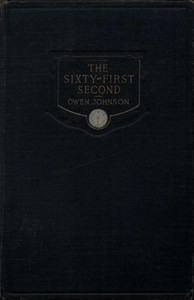
Before opening The Sixty-First Second — Inside the Classic, the edition data offers a quick orientation: 92,644 words, 6 hr 43 min estimated reading time, and 14 detected text sections.
The text analysis averages about 13.7 words per sentence, while the detected sections provide another way to judge how the source is divided.
Project Gutenberg metadata also associates the work with “Detective and mystery stories,” connecting these edition facts with the source record’s subject description.
Explore this collection
These alternatives are selected using recorded categories and estimated reading time.
About 394 minutes
Relationships Society Historical Narratives
90,547 recorded words. 9 minutes difference from this book's estimate.
View Gutenberg source #37481About 424 minutes
Relationships Society Historical Narratives
97,510 recorded words. 21 minutes difference from this book's estimate.
View Gutenberg source #36705About 433 minutes
Relationships Society Historical Narratives
99,374 recorded words. 30 minutes difference from this book's estimate.
View Gutenberg source #36490Search stored excerpts and compare books → Choose by your preferences →
Choices use stored catalog measurements. Estimates vary with reading speed. A shared category is a catalog label, not a claim that two books have the same argument or literary quality.
Search reads excerpt text stored with this catalog and links to its associated Gutenberg record. The connection is stored in the site database; this tool does not recheck that every excerpt is word-for-word identical to that external record. Excerpt search does not cover every chapter and does not verify historical publication dates.
Catalog snapshot checked: 2026-09-26. Coverage: 93 public books, 93 available source excerpts.
Calculated from edition completeness, EPUB availability, text structure and catalogue metadata. Not a user rating.
Total of 100 points, scaled to a 2.5-5.0 range. Editions with an empty description or a missing EPUB file are not scored.
Public-domain source text
The source text is kept in the dedicated reader, separate from this catalogue record and its commentary.
The novel opens with a financial panic looming over New York in October of an unspecified year, immediately establishing a world where fortunes are made and lost in a frenzy. Johnson contrasts two titans: Bernard L. Majendie, a patrician from an old American family, and John G. Slade, a self-made promoter from the lowest depths of society. This opposition—old money versus new, inherited status versus earned wealth—sets the stage for a mystery that is as much about social tensions as about a stolen ring.
The theft occurs during a dinner party, and the investigation by detective McKenna reveals layers of concealment. The ring's history ties Slade to Mrs. Kildair, who prefers to lose it rather than expose how it came to her. McKenna's methodical approach—running down every alley—drives the narrative, but the excerpts show that the characters' motives remain deliberately ambiguous.
The opening chapter introduces two financial giants who embody opposing social forces. Bernard L. Majendie is described as a member of every exclusive club, a patron of the arts, and a representative of one of the oldest American families. In contrast, John G. Slade is a promoter and manipulator who hauled himself out of the lowest depths of society. Their shared peril in the looming panic creates a dramatic tension: which type of man will survive? Johnson uses this dichotomy to explore class dynamics in early 20th-century New York. The public, we are told, perceives only these two figures as the center of the financial drama, humanizing the abstract catastrophe. This framing suggests that the mystery will be as much about social identity as about the theft itself.
Detective McKenna emerges as a methodical investigator who distrusts easy conclusions. In the excerpts, he outlines his approach: by patience and by running down every alley till we find it is an alley. He considers multiple motives for the ring's theft, including the possibility that Slade himself took it after a quarrel with Mrs. Kildair. McKenna is careful not to assume guilt, noting that there is one thing no human being can ever say offhand about a woman's situation. His questions to Beecher and Gunther reveal his focus on who knew about Slade's gift and who might have needed money quickly. The detective's skepticism extends to the police detectives hired by Mrs. Kildair, wondering if they were told to search or told not to find the ring. This layered suspicion keeps the reader uncertain about the true culprit.
The stolen ring is more than a valuable object; it is a clue to a hidden relationship. McKenna deduces that Mrs. Kildair prefers to lose the ring rather than have it discovered how it came to her, implying a connection to Slade that she wishes to conceal. Beecher, who knows her, is perplexed: I don't believe it. She's deeper than that. The detective's theory that the thief knew enough of the ring's history to exploit Mrs. Kildair's silence adds a layer of blackmail to the plot. The excerpts do not reveal the full nature of her relationship with Slade, but the tension is palpable. When McKenna receives a phone call from someone he expected—and Gunther guesses it is Slade—the story hints at a direct confrontation between the detective and the tycoon. The reader is left to wonder what Slade knows and what he might reveal.
Readers should pay close attention to the social cues and class distinctions that Johnson weaves into the dialogue and descriptions. The financial panic is not merely a backdrop but a force that shapes characters' decisions and alliances. The mystery of the ring is intertwined with questions of reputation and power, and McKenna's investigation reveals as much about the characters' social positions as about their guilt. The novel rewards careful reading of its period details and the subtle ways characters reveal or conceal their motives.
Some mysteries hide their treasures in vaults, others in the silences between old loyalties. Owen Johnson’s The Sixty-First Second feels that way—secrets pressed against fine linen. So too, I find, does My Lords of Strogue, Vol. 1 (of 3) A Chronicle of Ireland, from the Convention to the Union — Background and Themes, where inheritance and hidden motive bind a people as tightly as any Wall Street panic. A quiet kinship, indeed.
Save your reaction, strongest insight, and memorable passage.